










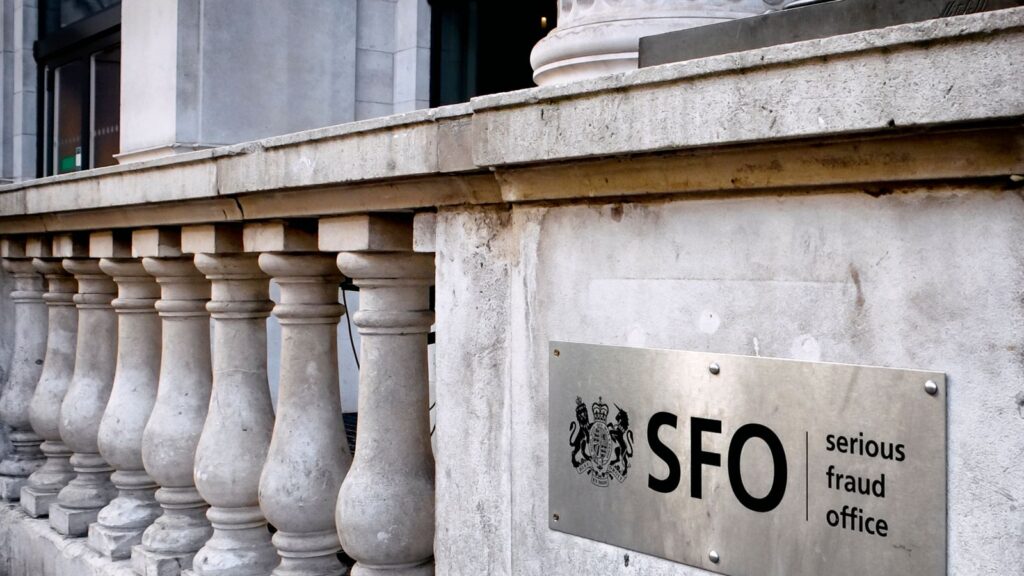
The UK government has indicated that it intends to strengthen the investigative powers of the Serious Fraud Office (SFO), potentially bringing its capabilities closer to those of the National Crime Agency (NCA). The commitment, made in Parliament on 18 November 2026, comes amid wider reforms to corporate criminal liability and follows renewed scrutiny of the SFO’s handling of the LIBOR scandal.
With several relevant pieces of legislation already in the parliamentary pipeline, businesses could face a more powerful economic crime enforcement agency as early as 2027.
From the LIBOR scandal to legislative reform
The parliamentary exchange followed the Court of Appeal’s judgment in R v Alex Pabon and others [2026] EWCA Crim 1457, handed down on 13 November 2026. The case concerned the financial consequences of overturned convictions relating to the manipulation of LIBOR and EURIBOR benchmark interest rates, following the Supreme Court’s landmark decision in July 2025 to quash the convictions of former traders Tom Hayes and Carlo Palombo.
The Court of Appeal concluded that it lacked jurisdiction to award interest on sums being returned to the former defendants. However, it considered that fairness required the SFO and HM Courts and Tribunals Service to honour their previous commitment to pay interest, rather than requiring the individuals to pursue further civil litigation.
During questions about the effectiveness of the SFO, Catherine Atkinson MP, chair of the Justice Select Committee, separately raised the need for stronger investigative powers, particularly in relation to surveillance and accompanying police officers during searches.
Solicitor General Andy Slaughter agreed, confirming that the government would:
“Seek a suitable legislative vehicle to strengthen them for complex investigations in the future.”
While the LIBOR judgment itself did not identify a need for stronger investigative powers, the parliamentary exchange highlights the competing pressures facing the SFO: improving its effectiveness as a prosecutor while ensuring accountability for its investigative and prosecutorial decisions.
What new powers could the SFO receive?
The SFO already possesses considerable compulsory investigative powers under section 2 of the Criminal Justice Act 1987, including the ability to compel individuals to answer questions and organisations to produce documents. However, its investigators remain dependent on police forces for certain operational activities, including the execution of search warrants.
Reform could give the SFO greater operational independence when conducting searches and accessing evidence, alongside more efficient access to covert surveillance capabilities. The precise scope of these powers, including the authorisation requirements and safeguards that would accompany them, has yet to be determined.
The proposals reflect ambitions already articulated by SFO director Graham McNulty. Speaking in June 2026, McNulty criticised the reluctance of law enforcement agencies to deploy intrusive investigative techniques against white-collar criminals and confirmed that he was working with the government to improve the SFO’s surveillance capabilities.
His ambition is to develop a more proactive enforcement agency, capable of identifying criminality independently rather than relying as heavily on corporate self-reporting and external referrals.
How quickly could the new powers become law?
The government’s reference to finding a suitable legislative vehicle is significant. Rather than introducing a standalone economic crime bill, ministers could incorporate additional SFO powers into legislation that is already progressing through Parliament or scheduled for introduction.
The forthcoming Police Reform Bill, announced in the May 2026 King’s Speech, is a particularly relevant candidate. The legislation is expected to restructure national policing capabilities, establish a National Police Service incorporating the National Crime Agency, and modernise the legal framework governing certain surveillance technologies. Strengthening the SFO’s investigative capabilities could fit within these broader reforms.
Another potential, albeit less straightforward, vehicle is the Courts and Tribunals Bill, which has already passed through the House of Commons and is scheduled for report stage in the House of Lords on 1 December 2026. The bill already contains provisions introducing judge-only trials for certain complex fraud and financial crime cases. Additional investigative powers would need to fall within the permissible scope of the legislation.
Attaching reforms to an existing bill could considerably shorten the legislative timetable. Royal Assent during 2027, potentially followed by relatively rapid commencement, is a plausible scenario. Unlike new corporate compliance obligations, changes to investigative powers would not necessarily require an extended transition period for businesses. No government amendment introducing these powers has yet been identified, and ministers have not confirmed which legislative route they intend to pursue.
What could stronger SFO powers mean for businesses?
Businesses facing an SFO investigation could find themselves subject to more extensive and intrusive evidence-gathering activities, potentially before they are even aware that an investigation is underway. Greater operational independence could facilitate more timely dawn raids, searches of commercial premises and the seizure of digital records, while expanded surveillance capabilities could help investigators corroborate evidence independently of information supplied by the company.
These developments also have implications for how businesses respond to suspected internal wrongdoing. Under the SFO’s corporate cooperation guidance, updated in October 2026, organisations that promptly self-report and cooperate fully will ordinarily be invited to negotiate a deferred prosecution agreement (DPA), barring exceptional circumstances.
As the SFO becomes better equipped to uncover wrongdoing itself, businesses may have a narrower window in which to identify, investigate and voluntarily disclose suspected criminal conduct before enforcement authorities become aware of it. As McNulty warned in June:
“Not self-reporting is a gamble and the odds are getting worse.”
Organisations should ensure that their investigation response procedures are up to date, including arrangements for responding to dawn raids, preserving electronic evidence, protecting legally privileged material and escalating suspected criminality to senior management and legal advisers.