









For years, companies have been able to say that supply chains are too complex to fully trace. Products may pass through multiple farms, processors, labour providers, contractors, subcontractors, distributors and retailers before reaching the shelf. Records may be incomplete, fragmented or held by different organisations across different jurisdictions. By the time a product reaches the consumer, the people who produced it can feel several steps removed from the company selling it.
A recent paper on one of the largest forced labour prosecutions in US history challenges that assumption directly.
In Piercing the Corporate Opacity Myth: Forced Labor, Supply Chain Traceability, and Constructive Ignorance, Bridgette Ann Carr, Seth Guikema, Ankit Raghunath and Karma Karira argue that supply chain opacity is not always an unavoidable commercial reality. In some cases, it is a legal, institutional and corporate construct. Their paper uses Operation Blooming Onion, a major US labour trafficking case, to show how forced labour risks were traceable using publicly available information.
The conclusion is uncomfortable for businesses. If public information can connect forced labour to products reaching supermarket shelves, companies may find it harder to argue that they could not have known.
What was Operation Blooming Onion?
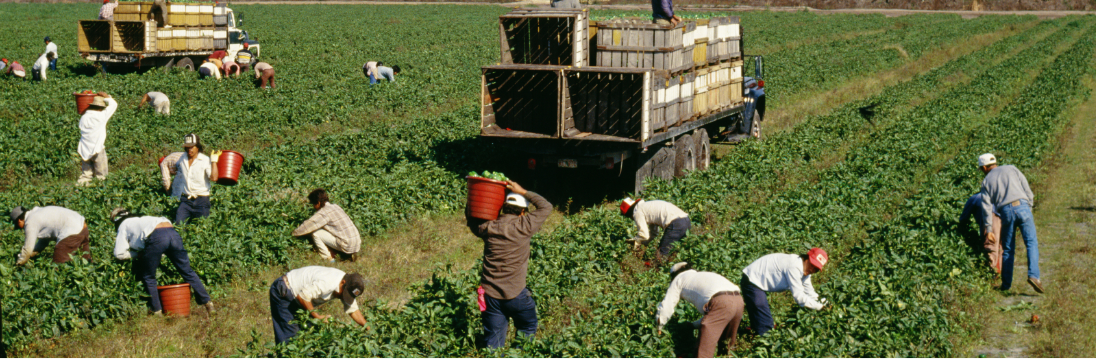
Operation Blooming Onion was a US federal investigation into a human smuggling and labour trafficking operation involving agricultural workers in South Georgia. In November 2021, the US Department of Justice announced a 54-count indictment against 24 defendants in USA v. Patricio et al., alleging a multi-year scheme that brought workers from Mexico, Guatemala and Honduras into the US under the H-2A agricultural visa programme.
According to the indictment described by the Department of Justice, workers were required to pay unlawful fees for transport, food and housing. Their travel and identity documents were allegedly withheld. They were allegedly forced to perform physically demanding work for little or no pay, housed in degrading and unsanitary conditions, and threatened with deportation or violence. Some workers were allegedly required to dig onions with their bare hands and were paid 20 cents per bucket harvested. The Department of Justice also said that at least two workers died as a result of workplace conditions and that the conspirators allegedly made more than $200 million from the scheme.
The case was shocking because of the severity of the alleged abuse. But for compliance teams, its significance goes further. It raises a harder question: how far down the supply chain can responsibility travel?
The supply chain question
Modern slavery cases are often discussed as if the abuse happens in a hidden part of the economy, far away from the finished product and impossible for downstream companies to identify.
The paper challenges that narrative. It explains that law students at the University of Michigan traced products harvested under forced labour in Operation Blooming Onion to national supermarket shelves using only publicly available records.
That finding matters because it reframes the problem. The issue is not simply whether forced labour exists somewhere deep in a supply chain. The issue is whether businesses are taking reasonable steps to identify and act on information that may already be available.
For compliance teams, that moves the conversation from “we could not know” to “what did we do to find out?”
Constructive ignorance and the risk of not asking questions
The paper’s legal argument focuses on the concept of constructive knowledge under US trafficking law. Under 18 U.S.C. § 1595, a victim may bring a civil action not only against the perpetrator, but also against anyone who knowingly benefits from participation in a venture that they “knew or should have known” was engaged in trafficking or forced labour violations.
That “should have known” standard is important. It means liability can turn on what a business ought reasonably to have discovered, not only what it actually knew.
The paper argues that where supply chains are demonstrably traceable, downstream companies should not be able to rely on broad claims of opacity to avoid accountability. If records, product flows, supplier relationships and public data can reveal forced labour links, then failing to investigate may start to look less like ignorance and more like avoidance.
This is the core compliance lesson. Ignorance is becoming harder to defend when the information is available, the risks are known and the company has chosen not to look.
Why this matters beyond the United States
Operation Blooming Onion was a US case, and the paper’s legal analysis focuses on US trafficking law. But the practical compliance implications are much wider.
In the UK, section 54 of the Modern Slavery Act 2015 requires certain organisations to publish an annual modern slavery statement setting out the steps they have taken to ensure slavery and human trafficking are not taking place in their business or supply chains. Updated UK government guidance says businesses should comply with both the letter and spirit of section 54.
That does not impose the same legal test as US trafficking litigation. But it does create an expectation of active supply chain governance. A statement that says little more than “our supply chains are complex” is unlikely to satisfy customers, investors, regulators, campaigners or procurement teams.
The direction of travel is clear. Modern slavery compliance is becoming less about broad policy commitments and more about evidence. Organisations are increasingly expected to show how they map supply chains, assess supplier risk, escalate concerns, investigate red flags and record decisions.
The practical compliance angle
The case highlights several practical steps organisations should take.
1. Map the real supply chain, not the ideal one
Many organisations have a clean, simplified view of their supply chain on paper. The real supply chain is often messier. It may include labour brokers, seasonal labour providers, subcontractors, recruitment agents and informal intermediaries.
Operation Blooming Onion shows why this matters. The labour abuse was connected to the way workers were recruited, transported, controlled and supplied to farms. A supplier due diligence process that only looks at the immediate contracting entity can miss the risks sitting behind it.
Compliance teams should ask:
- Who actually provides the labour?
- Are labour providers, agencies and subcontractors declared?
- Are workers paying recruitment fees?
- Are identity documents ever held by employers, recruiters or intermediaries?
- Are accommodation, transport or food charges being deducted from wages?
- Are workers able to raise concerns safely?
2. Treat public information as part of due diligence
The paper’s central finding is that public records could be used to trace products from forced labour conditions to supermarket shelves. That should change how organisations think about due diligence.
Modern slavery checks should not rely solely on supplier questionnaires. Publicly available information can provide valuable risk signals, including:
- litigation records
- enforcement notices
- import and shipment data
- company ownership records
- media reports
- NGO investigations
- worker complaints
- sanctions, debarment or procurement exclusion lists
- court documents
- geographic risk data
Supplier declarations still matter, but they are not enough on their own. A supplier saying “we comply with all laws” should be the start of the process, not the end of it.
3. Focus on benefit flows
One of the paper’s strongest arguments is that legal accountability should focus more closely on benefit flows. In plain English, who benefits from the cheap labour, low prices, fast supply or high margins created by exploitation?
That is a useful compliance lens. Modern slavery risk is not always obvious from the supplier’s name or country. Sometimes the red flag is commercial.
Questions to ask include:
- Is the price unrealistically low?
- Are lead times unusually tight?
- Is the supplier heavily dependent on seasonal or migrant labour?
- Is there pressure to meet demand at a cost that could only be achieved by underpaying workers?
- Are labour costs transparent and credible?
- Has the business challenged suspiciously cheap procurement?
Procurement teams need to understand that commercial pressure can create or increase modern slavery risk. A supplier risk assessment that ignores price, volume and delivery pressure is incomplete.
4. Record what was known, when it was known and what was done
A modern slavery programme must produce evidence. If a concern is raised, the organisation should be able to show how it was assessed, who reviewed it, what action was taken and why.
That includes documenting:
- supplier risk ratings
- information sources used
- enhanced due diligence checks
- decisions to approve, suspend or terminate suppliers
- remediation steps
- escalation to senior management
- worker engagement and grievance mechanisms
- follow-up reviews
The paper’s argument about constructive ignorance makes this even more important. If a risk was knowable, the organisation needs to show that it made a serious effort to know.
5. Train the teams closest to the risk
Modern slavery compliance cannot sit only with legal or compliance teams. Procurement, supplier management, HR, logistics, sustainability, operations and finance all need to understand the warning signs.
Training should be practical and role-specific. Procurement teams need to understand supplier red flags. HR and recruitment teams need to understand labour exploitation indicators. Finance teams need to recognise suspicious payment structures. Senior leaders need to understand the reputational, legal and operational consequences of weak due diligence.
The aim is not to turn every employee into an investigator but rather to make sure the right people know when to ask questions, when to pause and when to escalate.
Opacity is no longer a safe defence
Operation Blooming Onion is an extreme case, but the lesson for businesses is not limited to extreme facts.
The case shows how severe exploitation can sit inside apparently ordinary supply chains. The paper shows how those links may be more traceable than companies assume. Together, they point to a new compliance reality: organisations will be judged not only on what they knew, but on what they could reasonably have found out.
For modern slavery compliance, that means policies and statements are not enough. Businesses need working systems that connect supplier information, risk assessment, procurement decisions, escalation routes and evidence management.
The organisations best placed to manage this risk will be those that can show they took active steps to understand their supply chains. The weakest position will be reserved for those who treated complexity as a reason not to look.
The central question is simple: if a forced labour risk appeared in your supply chain, would your organisation be able to find it, act on it and prove what it did?
If the answer is uncertain, the next step is not another generic statement. It is better due diligence, better training and better evidence.
VinciWorks modern slavery training
VinciWorks’ modern slavery training helps organisations understand the risks of forced labour, human trafficking and exploitation in business operations and supply chains. Our training supports staff and managers to recognise red flags, escalate concerns and understand their role in preventing modern slavery.
For organisations reviewing their modern slavery compliance programme, training is a practical step towards building awareness, strengthening supplier governance and demonstrating that modern slavery risks are being taken seriously.
Ensure compliance with the Modern Slavery Act 2015
Train now →