




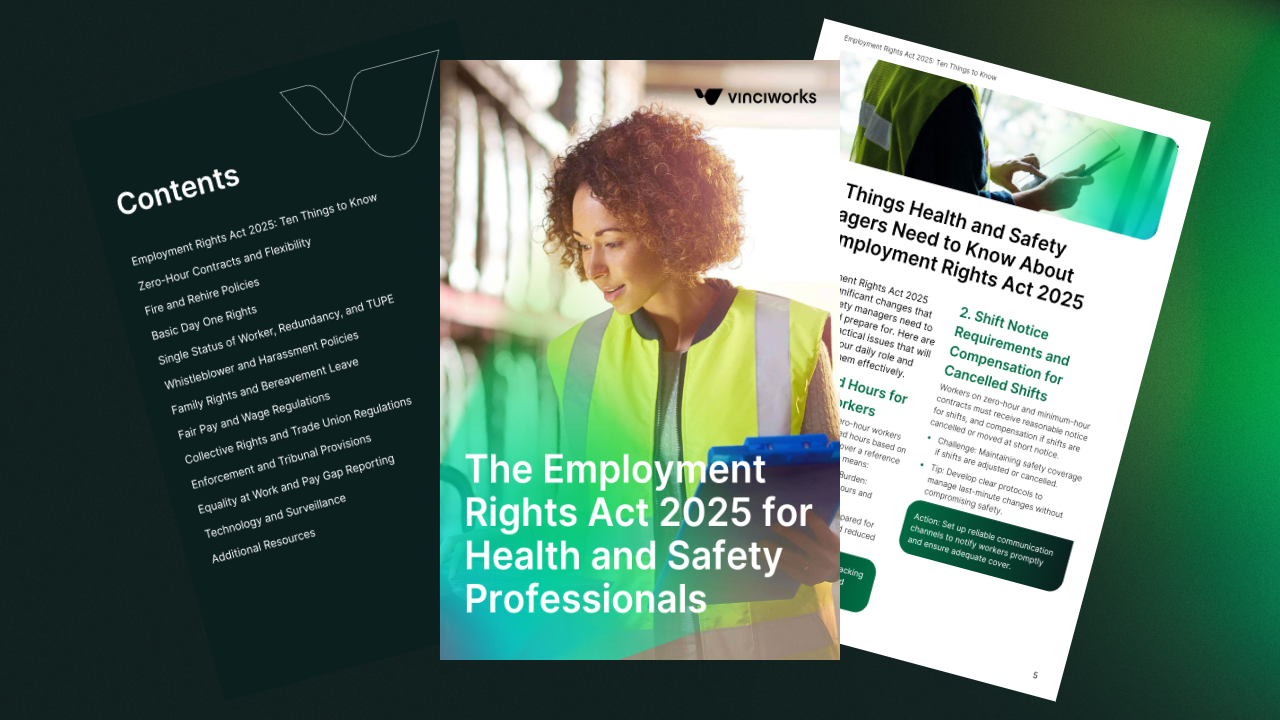
The Employment Rights Act completed its passage through Parliament at the close of 2025, marking one of the most significant and controversial employment law reforms in a generation. Employers now move from watching legislative debate to preparing for phased implementation across 2026 and 2027.
Our updated Employment Rights Act guide for Health and Safety Professionals reflects the final shape of the law and, critically, where the Act landed differently from earlier drafts.
Key changes from Bill to Act
One of the most important shifts concerns unfair dismissal. Early proposals pointed towards day one protection and a statutory probationary period. The final Act takes a more calibrated approach. The two year qualifying period has been reduced to six months, providing earlier protection for employees while avoiding a universal day one right. The proposed nine month statutory probation period has been dropped entirely.
Zero hour contracts also emerge with greater clarity. The Act now confirms that agency workers are fully included within the new guaranteed hours and reasonable notice regime. This is no longer subject to consultation. Regulations will define how agency contracts must adapt, with a 12 week reference period widely expected for calculating guaranteed hours.
The final text also strengthens remedies. Protective awards for failures to consult in collective redundancy situations double to 180 days’ pay. Sexual harassment disclosures are explicitly brought within whistleblowing protections. These changes materially increase both legal risk and compliance expectations.
Employment Rights Act implementation timeline
The Act is deliberately staged, giving employers time to adapt policies, contracts and systems.
18 December 2025
- Minimum service level rules for strikes are removed.
- Trade union ballot thresholds are simplified, moving to a simple majority.
February 2026
- Dismissal for taking part in lawful industrial action becomes automatically unfair.
- Notice periods for industrial action reduce from 14 to 10 days.
- There is no longer a legal requirement for picket supervisors.
April 2026
- Statutory Sick Pay becomes payable from day one of illness.
- Lower earnings limit for SSP eligibility is removed.
- Paternity leave becomes a day one right.
- Ordinary parental leave becomes a day one right.
- Paternity leave can be taken after shared parental leave.
- Protective award for failure to consult in collective redundancy doubles to 180 days’ pay.
- Sexual harassment disclosures gain whistleblowing protection.
October 2026
- Fire and rehire practices become automatically unfair in most circumstances.
- New tipping rules take effect, including mandatory consultation on tipping policies and three year policy reviews.
- Employment tribunal claim windows extend to six months for all claims.
January 2027
- Unfair dismissal protection applies after six months’ continuous service.
2027 (TBD)
- Flexible working rules tighten further. Employers rejecting a request must state the business reason and explain why refusal is reasonable.
What employers should be doing now
Although many obligations are phased, preparation cannot be. Employers should already be reviewing dismissal processes, zero hour arrangements, agency contracts, sickness absence policies and industrial relations frameworks.
Our updated guide to the Employment Rights Act for Health and Safety professionals reflects these changes and what teams should be thinking about now.